Most internal tools start as a simple dashboard. A few tables. A few reports. A login screen that solves one immediate problem.
BuildingControl started there too, but it did not stay there. As Evergreen kept growing, we needed more than a place to store records. We needed a system that could reflect how the operation actually moves: accounts, buildings, staffing, schedules, recruiting, supervision, time, and field execution.
That is what BuildingControl has become: the internal platform behind Evergreen's day-to-day operations.
Operational work tends to break apart fast. One tool for properties. Another for people. Another for schedules. Another for hiring. Then someone ends up reconciling everything by phone, spreadsheet, or memory.
We wanted one connected environment where the structure of the business and the reality of the field could meet. Not a generic software stack. Not a patchwork of disconnected apps. A system aligned with how Evergreen actually runs.
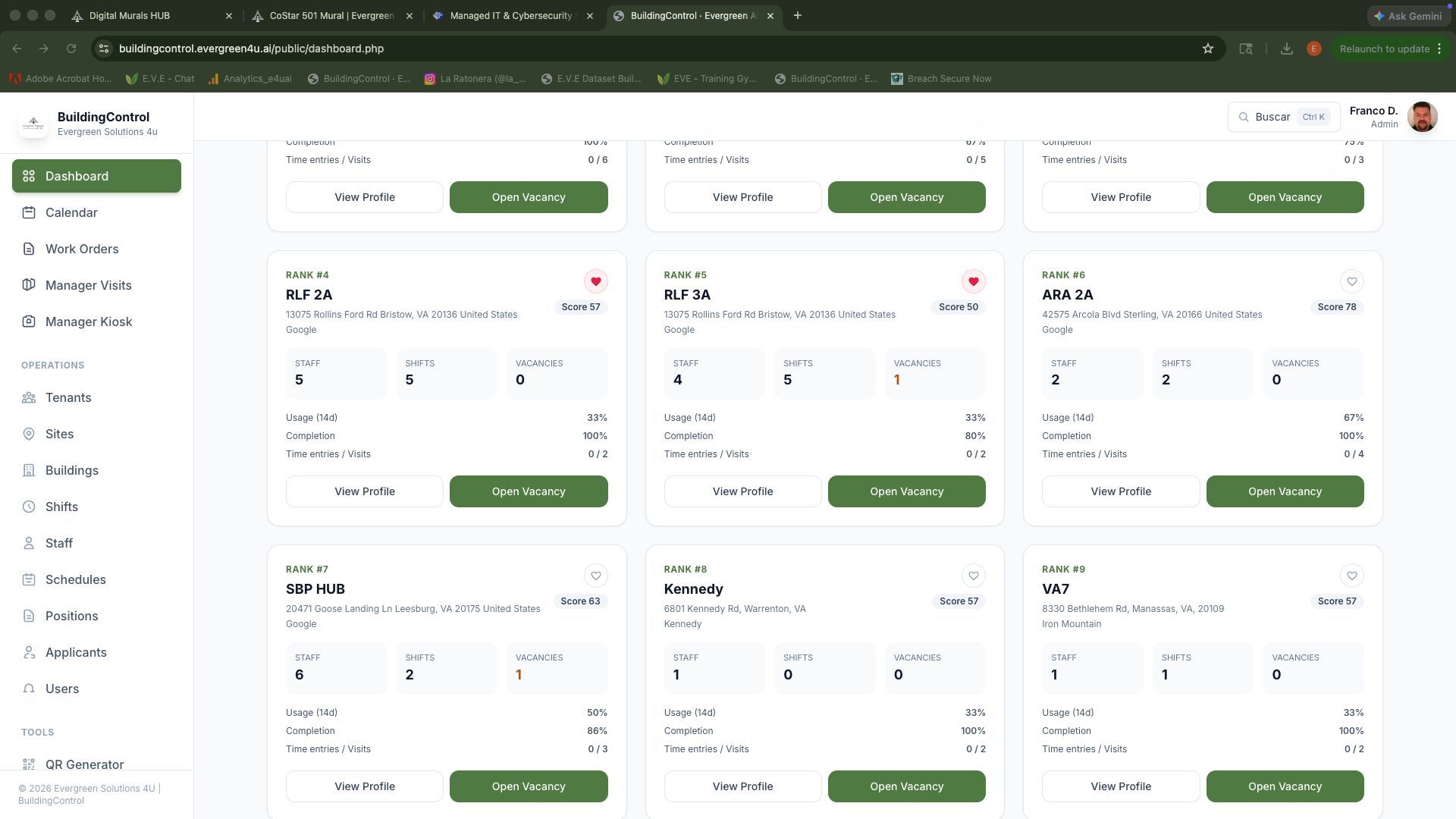
At first glance, BuildingControl looks like a building operations platform. It manages tenants, sites, properties, shifts, and staff. But the real value is in how those layers stay connected.
Instead of jumping between isolated views, managers can understand the structure and the operational context together.
One of the biggest lessons for us was that operations are never just about locations. They are about coverage, consistency, and visibility.
That is why BuildingControl keeps expanding around the workforce layer:
The result is simple: less guessing, fewer handoffs lost in conversation, and stronger control over who is assigned, who is active, and where the gaps really are.
We also knew that staffing data alone would never be enough. Real operations need visibility into what is happening in the field.
That is why BuildingControl includes modules like Manager Visits and Work Orders. These are not cosmetic add-ons. They close the loop.
Together, those layers make the system far more useful than a read-only admin portal.
Today, BuildingControl supports multiple parts of the business at once:
That breadth is exactly the point. Evergreen does not operate in neat silos, so the internal platform should not either.
Because the system has matured, we also created a public-facing product landing for it. The goal is simple: make it easier to explain what BuildingControl is before someone enters the private system itself.
If you want to see that presentation layer, you can explore the official page here: BuildingControl product landing.
BuildingControl is not just another internal tool in Evergreen's stack. It is becoming the digital operating layer that connects structure, staffing, supervision, and execution.
For us, that matters because better operations are rarely created by one feature. They come from better connection between all the moving parts.
And that is exactly what BuildingControl is designed to do.